How El Niño Could Influence U.S. Weather During the 2026–2027 Winter
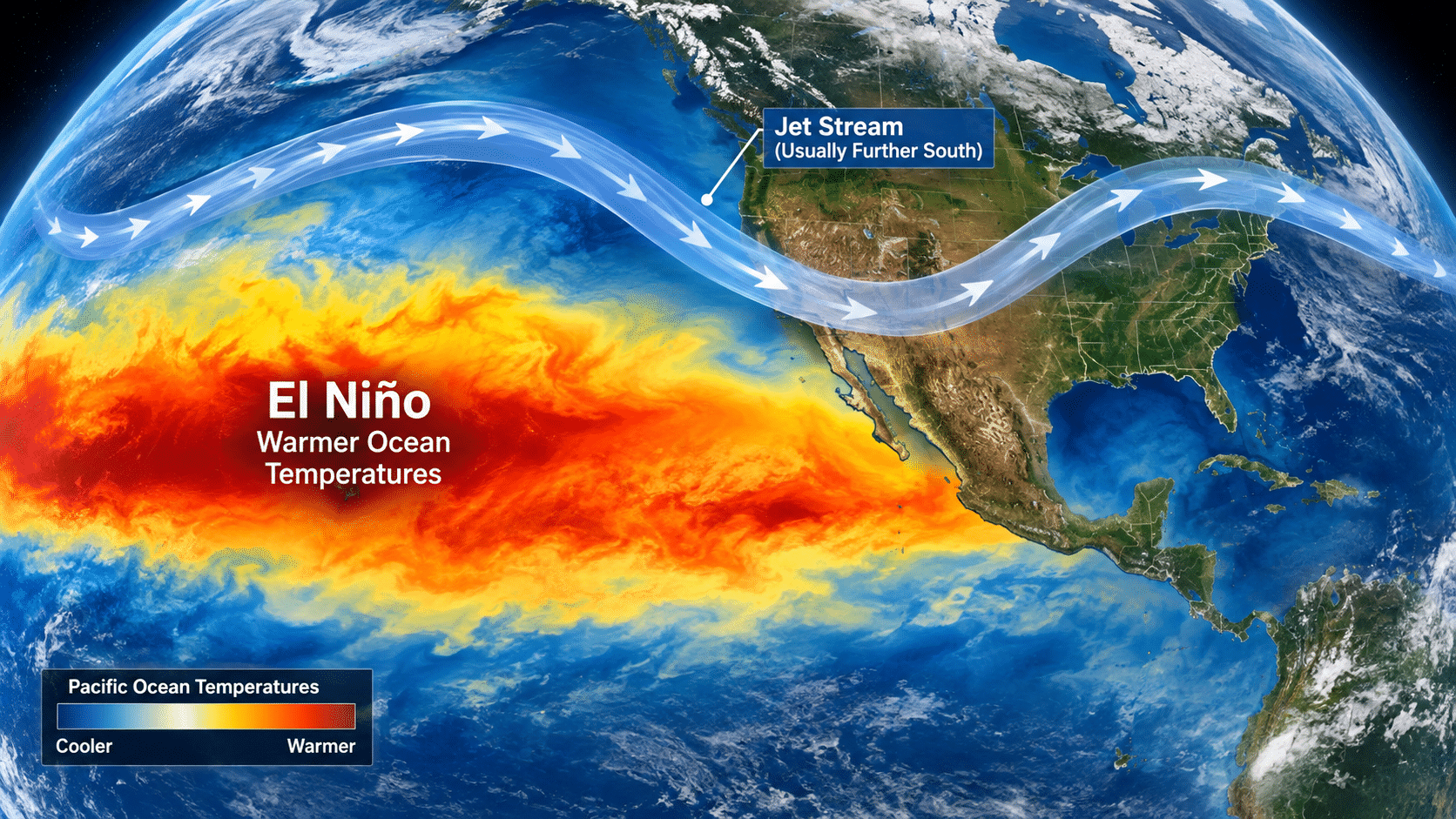
El Niño is one of those weather patterns that can have a much bigger impact than you might expect. Although it starts with changes in Pacific Ocean temperatures, its influence can reach much farther, affecting weather across the United States, and even further east to Europe. Depending on how the pattern develops, it can influence winter storms, rainfall, drought conditions, and even hurricane activity.
With a potentially strong El Niño developing for the 2026–2027 winter, there's plenty of reason to pay attention. Changes in seasonal weather patterns can affect businesses, property owners, insurance companies, and anyone who needs to understand weather-related risks.
For forensic meteorologists, El Niño provides another piece of information when examining past weather events.
What Is El Niño?
El Niño is often described as a warming of the Pacific Ocean, but there's more to it than that. It's one phase of a natural climate pattern called the El Niño-Southern Oscillation, or ENSO, which involves changes in both ocean temperatures and atmospheric conditions across the tropical Pacific.
Under normal conditions, trade winds push warm surface water toward the western Pacific. When El Niño develops, those winds weaken, allowing warmer water to spread farther east toward South America.
That shift might seem like a relatively small change in the ocean, but it can influence how heat and moisture move through the atmosphere. Those changes can affect the jet stream, which in turn influences where storms develop and how they travel.
El Niño events generally occur every two to seven years and typically last around nine to 12 months, according to NOAA. Not every event has the same strength, either. Some produce noticeable changes in weather patterns, while others have a more limited influence. The time of year and other atmospheric conditions also help determine what happens.
A Strong El Niño Could Develop During the 2026–2027 Winter
There's already considerable interest in the developing El Niño pattern. In October 2026, NOAA's Climate Prediction Center reported that the event was continuing to strengthen, with an 83% or greater chance of a strong-to-very-strong El Niño persisting through January–March 2027.
If those projections hold, the event could become one of the strongest observed since records began in 1950.
A stronger El Niño generally increases the likelihood of certain weather patterns, but that doesn't mean every part of the country will experience the same conditions.
NOAA's winter outlook calls for an increased chance of warmer-than-average temperatures across much of the northern United States. Wetter-than-average conditions are also favored across parts of the southern United States and along the East Coast.
It's important to understand what these outlooks mean. They're based on probabilities over an entire season, not predictions of what the weather will look like on a particular day. Even in a winter expected to be warmer overall, individual cold fronts, snowstorms, or severe weather events can still occur.
For anyone evaluating weather risks, that distinction is important. Seasonal patterns offer a general idea of what may be ahead, but they don't replace a closer look at individual weather systems.
How El Niño Can Change Weather Across the United States
One reason El Niño has such a noticeable effect on U.S. weather is its influence on the jet stream. The Pacific jet stream is essentially a fast-moving current of air that moves from west to east high in the atmosphere that helps direct storms across North America.
During many El Niño winters, the jet stream moves farther south than usual. This can steer more storm systems across the southern United States, increasing the chances of rainfall and unsettled weather from California through the Gulf Coast and toward the East Coast.
For some areas, that may mean a wetter winter. Depending on the timing and strength of individual storms, the weather can include heavy rainfall, flooding, severe thunderstorms, or winter precipitation. Farther north, temperatures often trend milder during El Niño winters, although that certainly doesn't rule out occasional cold outbreaks or significant snowstorms.
These patterns help meteorologists understand the conditions that may favor certain types of weather. However, knowing that El Niño is present doesn't tell us exactly what happened during an individual storm. That requires a much closer examination of the available weather data.
El Niño had a huge impact on the Atlantic Basin 2026 season, which had just 10 named storms. That was the lowest total since 2014 when there were eight named storms.
This also marked the first time there was just one hurricane in a season since 1925. The only hurricane in 2026, Hurricane Isaias in October, had the distinction of being the latest hurricane in a season in 121 years.
Reconstructing Past Weather Conditions
Weather investigations often happen long after the event. By the time an insurance claim or legal case reaches the investigation stage, the storm may have passed weeks, months, or even years earlier.
That's where historical meteorological data becomes especially valuable.
When investigating a past weather event, forensic meteorologists look at historical records to piece together what conditions were like at the time. The specific data and analysis needed will depend on the incident, but the investigation may include:
- Wind analysis: Looking at recorded wind speeds, estimated gusts, damage reports, and surrounding storm conditions to determine whether wind may have contributed to property damage.
- Hurricane investigations: Reviewing a hurricane's path, wind speeds, and storm surge to better understand its potential effects on a specific location.
- Precipitation analysis: Examining how much rain fell, when it occurred, and how intense it was when investigating flooding or water damage.
- Severe weather investigations: Analyzing thunderstorms, hail, tornadoes, and other severe weather that may have caused damage or contributed to an incident.
- Winter weather analysis: Reviewing temperature records and other weather data to determine whether snow, sleet, freezing rain, or icy conditions were present.
The available evidence varies from case to case. Sometimes nearby weather stations provide detailed observations. Other investigations require comparing multiple data sources to develop a reliable estimate of conditions at a location with no direct measurements.
In either situation, the objective is the same: provide a clear, scientifically supported explanation of the weather conditions surrounding the event.
How Atlantic States Weather Can Help
At Atlantic States Weather, Inc., we work with attorneys, insurance professionals, businesses, and others who need reliable answers about past weather events.
Since 2004, our team has handled more than 850 cases involving weather-related damage, injuries, and other incidents. Our work includes historical weather research, forensic meteorological analysis, litigation support, insurance damage claims, personal injury cases, and expert testimony.
We investigate a wide range of weather events, including hurricanes, thunderstorms, hail, tornadoes, flooding, winter storms, and marine conditions. Depending on the needs of a case, we can research historical weather records, reconstruct wind conditions, analyze storm surge, review another expert's findings, and prepare technical reports for legal proceedings.
Just as importantly, we understand that not everyone involved in a case has a meteorological background. Part of our job is explaining complicated weather information in a way that's clear, useful, and supported by the available evidence.
As El Niño continues to influence the broader weather patterns of the 2026–2027 winter, it will be interesting to see how those conditions develop across the country. But when it comes to investigating a specific weather-related incident, the larger climate pattern is only the starting point.
Understanding what actually happened requires looking at the weather conditions for that particular place and time. With reliable historical data and careful scientific analysis, Atlantic States Weather helps clients get a clearer picture of past weather events and the role they may have played in an insurance claim or legal dispute.